International Remittance Market

Remittance Market Growth and Share, Rising Trends, Demand, Technologies, Challenges, Future Opportunities and Forecast 2033: SPER Market Research

The act of sending money from one country to another is referred to as international remittance. Usually, this is done by people who are working or living abroad and sending money back to their home country. It is essential for facilitating cross-border business transactions, enabling family financial support, and promoting economic growth in recipient nations. Individuals can send money securely and conveniently through remittance services offered by banking institutions, money transfer companies, and online platforms. The exchange of one currency for another, frequently with fees and exchange rate charges, takes place during the procedure. Due to their ability to close the financial disparities between nations, international remittances promote financial inclusion and global economic integration.

According to SPER Market Research, ‘International Remittance Market Size- By Mode of Transfer, By Type, By Channel, By End User – Regional Outlook, Competitive Strategies and Segment Forecast to 2033’ state that the International Remittance is predicted to reach USD 487.80 billion by 2033 with a CAGR of 12.80%.

Numerous important elements are driving the enormous growth of the International Remittance Market. The industry’s expansion has also been aided by the growing knowledge and appreciation of the advantages legal remittance channels have over informal ones, such as cheaper fees, better security, and access to financial services. Programmes that promote financial knowledge and education have contributed to the growth of official remittance services.

The amount of remittance flows is influenced by economic variables like GDP growth, employment prospects, and income levels in both sending and receiving countries. Stable economic conditions and advantageous exchange rates may encourage people to send more money home.

However, there are also challenges facing the International Remittance Market. The absence of a strong technology infrastructure in some places, particularly in rural or poor areas, can obstruct the effective transfer of remittances. Digital payment systems with limited internet connectivity might be difficult for customers and service providers.

Request For Free Sample Report @ https://www.sperresearch.com/report-store/remittance-market.aspx?sample=1

On the market for international remittances, the COVID-19 pandemic has had a considerable effect. Remittance flows across borders have been hampered by the global economic downturn and travel restrictions put in place to combat the virus. Individuals’ capacity to send and receive remittances has been impacted by the drop in economic activity, job losses, and decreased income levels. The process of remittance has also been hampered by the closure of companies and remittance service outlets as well as restricted access to banking services. Furthermore, the market has been negatively influenced by the fluctuation in exchange rates and elevated transaction costs brought on by the economic unpredictability. As people increasingly use internet methods for sending and receiving money globally, the epidemic has, however, also sped up the development of digital remittance systems.

Geographically, Asia-Pacific emerged as the leading region in the remittance market and is projected to experience the fastest growth. This is attributed to the rising population of immigrants and the growing popularity of digital remittance due to advancements in technology, changing customer preferences, and evolving regulations. These factors are fueling the automation of cross-border and remittance services, making them more efficient and convenient. In addition, some of the market key players are Bank of America Corporation, Citigroup, Inc., MoneyGram International, Inc, OFX, PayPal, Wise US, Inc, ZEPZ, Others.

Remittance Market Key Segments Covered

The SPER Market Research report seeks to give market dynamics, demand, and supply forecasts for the years up to 2033. This report contains statistics on product type segment growth estimates and forecasts.

By Mode of Transfer: Based on Mode of Transfer, International Remittance Market is segmented as; Digital, Traditional (Non-digital).

By Type: Based on Type, International Remittance Market is segmented as; Inward Remittance, Outward Remittance.

By Channel: Based on the End User, International Remittance Market is segmented as; Banks, Money Transfer Operators, Online Platforms.

By Region: This report offers data concerning the significant regional segments, including the Asia-Pacific, Europe, the Middle East and Africa, North America, and Latin America.

For More Information, refer to below link:-

International Remittance Market Size

Related Reports:

KSA Personal Loan Market Size- By Type, By Marital Status, By Consumer Age, By End-User- Regional Outlook, Competitive Strategies and Segment Forecast to 2033

Open Banking Market Size-By Services, By Deployment, By Distribution Channel – Regional Outlook, Competitive Strategies and Segment Forecast to 2032

Follow Us –  

LinkedIn | Instagram | Facebook | Twitter

Contact Us:  

Sara Lopes, Business Consultant – USA

SPER Market Research

enquiries@sperresearch.com

+1-347-460-2899

Remittance Market Growth

Remittance Market Demand and Share 2023, Emerging Trends, Revenue, Technologies, Business Challenges, Future Opportunities and Forecast 2033: SPER Market Research

The transfer of money from one nation to another is referred to as the remittance industry. This commonly happens when an individual who is employed in a foreign country sends funds to relatives or close ones residing in their home country. This activity is of utmost significance in providing financial assistance to families who rely on it, and it can also benefit the economy of the receiving country by catering to essential needs such as education, housing, and food.

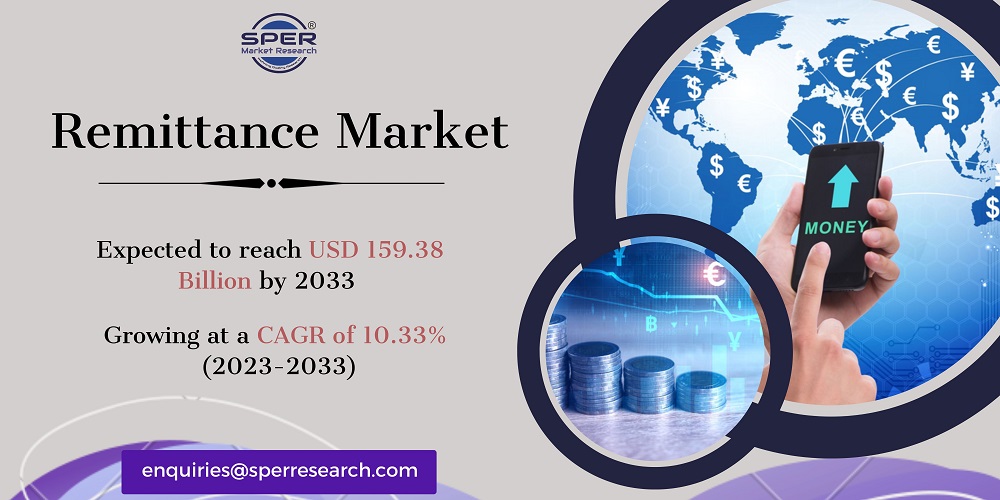
According to SPER market research, ‘Remittance Market Size- By Mode of Transfer, By Type, By Channel, By End User- Regional Outlook, Competitive Strategies and Segment Forecast to 2033’ state that the Global Remittance Market is estimated to reach USD 159.38 billion by 2033 with a CAGR of 10.33%.

The remittance market on a global scale has seen a gradual increase, and several factors have contributed to this trend. One of the most significant drivers of this growth is globalization, which has led to an increase in the number of people relocating to foreign countries for work or education. Consequently, there is an increasing demand for remittance services that enable them to send money to their family members and loved ones back in their home countries.

Furthermore, the growth of the remittance industry worldwide is also being driven by the widespread adoption of financial technology. With the introduction of digital platforms, it has become more convenient and effortless for people to transfer money across borders. This has given rise to the emergence of financial technology companies that offer cost-effective and efficient remittance services.

However, the global remittance market is encountering several challenges that are hindering its growth and effectiveness. One of the significant challenges is the high cost of transactions associated with remittance services. The expense of sending money across borders can be quite high, particularly for individuals who are transferring small amounts of money. This can be a burden for low-income families who depend on remittances for their daily expenses. Additionally, the remittance market is vulnerable to economic and political instability, which can affect the flow of funds. Changes in exchange rates, government policies, and natural disasters can disrupt remittance flows and make it difficult for people to send and receive money.

Impact of COVID-19 on Global Remittance Market

The significance of digital and mobile remittance services has been made clear by COVID-19. As physical stores close, more people are using online and mobile remittance platforms to send and receive money. This move towards digital channels has accelerated the adoption of digital technologies in the remittance market. Despite the pandemic’s challenges, a recovery in the international remittance market is anticipated over the following few years. The global economy is expected to grow and travel restrictions to loosen as more people return to work, which will increase the amount of money sent as remittances. It is also anticipated that the continued development of digital and mobile remittance services will contribute to the expansion of the remittance market in the post-pandemic era.

Request For Free Sample Report @ https://www.sperresearch.com/report-store/remittance-market.aspx?sample=1

Remittance Market Key Segments Covered

The SPER Market Research report seeks to give market dynamics, demand, and supply forecasts for the years up to 2033. This report contains statistics on product type segment growth estimates and forecasts.

Geographically, The region of Asia-Pacific is expected to grow at the fastest rate in the coming years. This is so because it is home to important recipients like China, the Philippines, and India. Important players from all over the world are also vying for the region’s expanding market. Additionally, some of the market key players of global remittance market are Bank of America Corporation, Citigroup Inc., MoneyGram International Inc., OFX, PayPal, Others.

For More Information, refer to below link:-

Remittance Market Growth

Related Reports:

Open Banking Market Size-By Services, By Deployment, By Distribution Channel – Regional Outlook, Competitive Strategies and Segment Forecast to 2032

IoT in Banking and Financial Services Market- By Solution, By Service, By End-User, By Organization Size- Regional Outlook, Competitive Strategies and Segment Forecast to 2032

Follow Us –  

LinkedIn | Instagram | Facebook | Twitter

Contact Us:  

Sara Lopes, Business Consultant – USA

SPER Market Research

enquiries@sperresearch.com