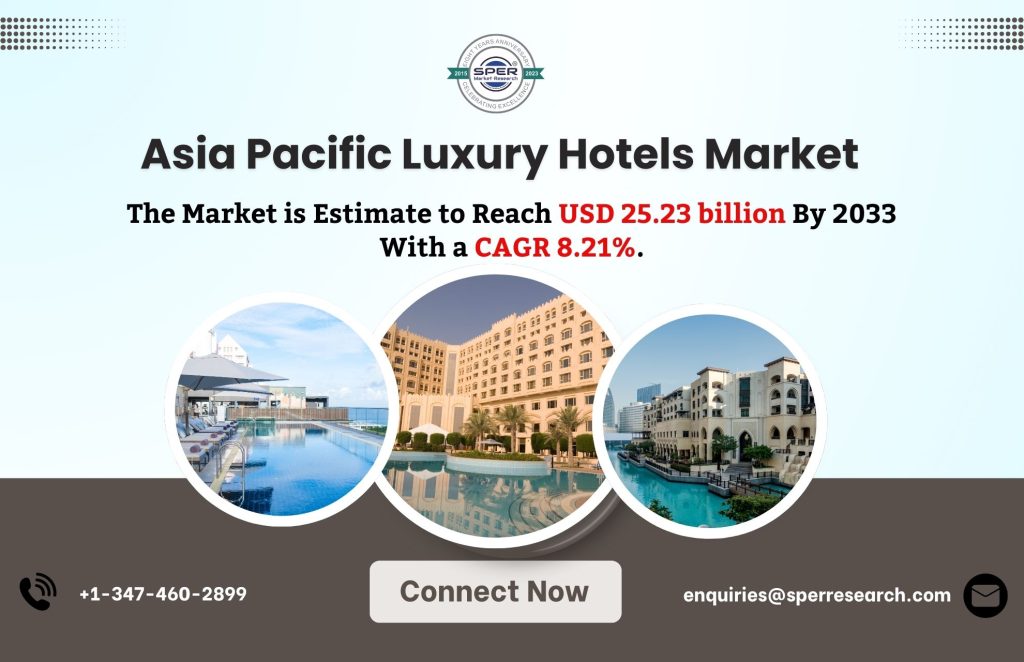
Asia-Pacific Luxury Hotels Market Trends and Analysis 2033

Luxury hotels are first-rate lodging facilities that provide outstanding comfort, individualized attention, and upscale amenities to provide visitors a sumptuous and unforgettable stay. Elegant architecture, exquisite eating establishments, spas and wellness centers, concierge services, and luxurious lodging are common features of these hotels. Luxurious hotels are found in popular locations, from major cities to far-flung retreats, and serve wealthy visitors, businesspeople, and travelers looking for the highest standards of elegance and quality. They usually set industry standards for hospitality, focusing on service, seclusion, and atmospheric elegance. The demand for luxury hotels is still being driven by the growth in wellness tourism, international travel, and immersive stays.

According to SPER Market Research, “Asia Pacific Luxury Hotels Market Size- By Service Type, By Category, By Room Type- Regional Outlook, Competitive Strategies and Segment Forecast to 2033” states that Asia Pacific Luxury Hotels Market is estimated to reach 25.23 USD billion by 2033 with a CAGR of 8.21%.

Drivers:

Rising worldwide travel, rising disposable incomes, and a growing desire for distinctive, upscale travel experiences are the main drivers of the luxury hotel sector. Luxury hotels are built to provide the individualized attention, comfort, and unforgettable experiences that today’s tourists seek for above and beyond simple lodging. Demand is also fueled by the rise in corporate travel, wellness tourism, and destination weddings. Furthermore, a wider audience now views luxury vacations as aspirational due to the popularity of these trips and the impact of social media and travel influencers. Guest pleasure is increased by technological innovations like smart room features and easy booking processes. Additionally, luxury hotels are being influenced by environmental consciousness to implement sustainable practices, drawing in eco-aware, high-end tourists.

Asia-Pacific Luxury Hotels Market Sample in PDF Format, Click Here

Restraints:

Despite rising demand, there are a number of obstacles facing the luxury hotel sector. Profitability may be strained by high operating costs, such as premium staffing, maintenance, and service quality. High-end travel is greatly impacted by global concerns like pandemics and political unrest as well as economic downturns. Constant innovation and customization are necessary due to shifting consumer tastes, yet they can be resource-intensive. Alternative luxury lodging options such as boutique resorts and upscale Airbnb rentals are becoming more and more competitive. Furthermore, excellent service delivery is necessary to manage guest expectations in a world that is hyperconnected and review-driven. Additionally, there are increasing demands for sustainability, necessitating investments in environmentally friendly activities and infrastructure. Maintaining brand identity while finding a balance between accessibility and exclusivity remains a significant challenge for luxury hotels.

China held the biggest revenue share in the Asia Pacific Luxury Hotels Market. This dominance is attributed due to its vast affluent population, increasing demand for unique luxury experiences, high outbound travel rates, and significant domestic luxury hotel development. Some of the key market players are Aman Resorts, Banyan Tree Hotels & Resorts, Four Seasons Hotels and Resorts, Hyatt Group, JW Marriott and Mandarin Oriental Hotel Group.

For More Information, refer to below link: –  

Asia-Pacific Luxury Hotels Market Growth

Related Reports:  

United States Spa Market Growth

Saudi Arabia Men’s Grooming Products Market Growth

Follow Us – 

LinkedIn | Instagram | Facebook | Twitter 

Contact Us: 

Sara Lopes, Business Consultant — USA 

SPER Market Research 

enquiries@sperresearch.com 

+1–347–460–2899
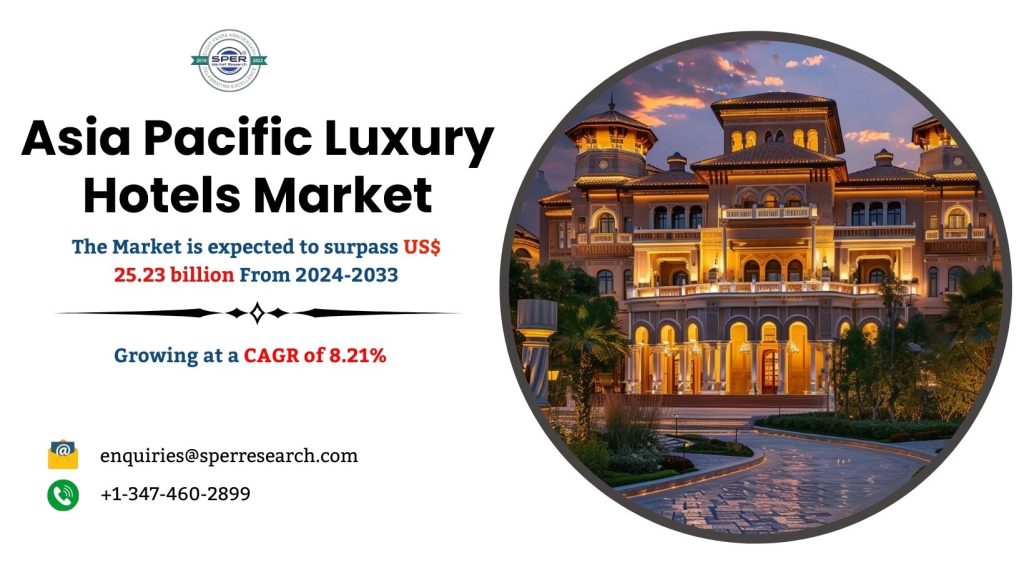
Asia Pacific Luxury Hotels Market

Asia Pacific Luxury Hotels Market Share, Industry Trends, Growth Drivers, Revenue, Demand, Challenges, Key Players, CAGR Status and Competitive Analysis 2024-2033: SPER Market Research

Market Overview and Growth Insights: Luxury hotels are upscale accommodations designed to meet the demands of wealthy tourists through providing outstanding comfort, facilities, and services. Offering visitors an unequaled degree of luxury and individualized service, these hotels are distinguished by their meticulous attention to detail, prime locations, and first-rate accommodations. Modern fitness centers, fine dining restaurants, spas and wellness centers, roomy rooms or suites, creative design, and a variety of first-rate amenities including room service, butler service, and concierge are all common features of luxury hotels. Through custom services, seclusion, and an emphasis on exclusivity, they hope to provide visitors an experience they won’t soon forget. Luxury hotels are well-liked by celebrities, business leaders, and affluent travelers. They are the industry standard for luxury and hospitality.

As per SPER Market Research, the report titled Asia Pacific Luxury Hotels Market Size – By Service Type, By Category, By Room Type – Regional Outlook, Competitive Strategies, and Segment Forecast to 2033’ highlights that the Asia Pacific luxury hotel market is projected to achieve a value of USD 25.23 billion by 2033, growing at a compound annual growth rate (CAGR) of 8.21%.

Drivers: The market is growing because more people are choosing recreational vacations. Globalization, the term used to describe the growing interdependence of economies, communities, and cultures worldwide, is anticipated to benefit the luxury hotel sector in Asia-Pacific. The world is getting narrower as a result of people traveling around more quickly. However, as incomes and employment possibilities have increased, people have gained confidence in their spending patterns, and a significant amount of the population can now afford to indulge in luxury purchases, at least sometimes, if not often. Luxury hotel chains are growing as a result of rapid urbanization and the construction of top-notch infrastructure, such as transportation networks and airports.

Download sample PDF copy of this report to understand structure of the complete report @ https://www.sperresearch.com/report-store/asia-pacific-luxury-hotels-market.aspx?sample=1

Restraints: Maintaining excellent service and client satisfaction standards is an important challenge preventing the market from growing. The APAC region’s luxury hotel market serves the business and tourism sectors, where people are looking for great experiences and a high level of living. Retaining a high standard of cleanliness, comfort, and service is essential to drawing in and keeping discriminating visitors. However, these criteria call for ongoing expenditures for capital-intensive and expensive maintenance and renovation projects. However, this emphasis on providing excellent customer service results in increased operating expenses, which can reduce profit margins and restrict the growth of upscale hotels in the Asia-Pacific area.

Impact of COVID-19: The travel and tourism sectors have suffered as a result of the COVID-19 pandemic. Regionally widespread social segregation, domestic laws that promote such behavior, and travel restrictions have all slowed the expansion of the luxury hotel industry. The industry was further strained by the cancellation of major events and business trips. But for many luxury hotels, “staycations” and domestic travel have become crucial survival strategy, appealing to local tourists looking for upscale and secure retreats. In order to adapt, hotels improved their health and safety procedures, provided flexible booking alternatives, and made investments in technological advancements like virtual concierge services and contactless check-ins. Recovery has been slow despite these measures, and the industry is largely dependent on the return of foreign travel.

Key Players: Asia Pacific Luxury Hotels Market was controlled by the china market due to its increasing number of wealthy people, strong economic expansion, and strong desire for first-rate travel experiences. Some of key players are Aman Resorts, Banyan Tree Hotels & Resorts, Four Seasons Hotels and Resorts, Hyatt Group, JW Marriott.

Asia Pacific Luxury Hotels Market Segmentation:

By Service Type: Based on the Service Type, Asia Pacific Luxury Hotels Market is segmented as; Business Hotels, Airport Hotels, Suite Hotels, Resorts, Others.

By Category: Based on the Category, Asia Pacific Luxury Hotels Market is segmented as; Chains, Independent.

By Room Type: Based on the Room Type, Asia Pacific Luxury Hotels Market is segmented as; Luxury, Upper-Upscale, Upscale.

By Region: This research also includes data for Australia, China, India, Japan, South Korea, Rest of Asia-Pacific.

For More Information in Asia Pacific Luxury Hotels Market, refer to below link –

Asia Pacific Luxury Hotels Market Share

Others Industry Report –

  1. Saudi Arabia Apparel Market Size- By Category- Regional Outlook, Competitive Strategies and Segment Forecast to 2033
  2. Barcode Decoding Software Market Size- By Deployment Mode, By Application- Regional Outlook, Competitive Strategies and Segment Forecast to 2033

Follow Us –

LinkedIn | Instagram | Facebook | Twitter

Contact Us:

Sara Lopes, Business Consultant – U.S.A.

SPER Market Research

enquiries@sperresearch.com

+1-347-460-2899

Asia Pacific Luxury Hotels Market

Asia Pacific Luxury Hotels Market Size, Share, Rising Trends, Key Manufactures and Future Opportunities 2033: SPER Market Research

A luxury hotel is a type of lodging that focuses on giving visitors an extraordinary experience rather than just offering standard comforts. These hotels are distinguished by their ideal settings, which are frequently found in posh areas or well-known tourist attractions. There is sophistication and elegance in the architecture and interior design. Luxurious hotels provide large, well-furnished rooms with state-of-the-art equipment. Another distinguishing feature is the high staff-to-guest ratio, which guarantees that every demand is met quickly. There are usually on-site fine dining alternatives available, with gourmet meals cooked by trained chefs. Modern workout facilities, top-notch spas, and occasionally even personal butlers are examples of extra luxuries.

According to SPER Market Research, Asia Pacific Luxury Hotels Market Size- By Service Type, By Category, By Room Type, – Regional Outlook, Competitive Strategies and Segment Forecast to 2033’ states that the Asia Pacific Luxury Hotels Market is estimated to reach USD 25.23 billion by 2033 with a CAGR of 8.21%.

There are several important elements that propel the luxury hotel business in Asia-Pacific. The strong economic growth in the area has increased disposable income, which in turn has increased demand for upscale lodging. Fast infrastructural development and urbanization, especially in large cities, improve accessibility and draw tourists from abroad. Luxury travel is being driven by the expanding middle class and the growing number of high-net-worth individuals. Improved air transport routes and digital marketing innovations broaden the market reach of enhanced connectivity. Furthermore, luxury service innovation is fueled by the trend toward experiential travel, where visitors look for one-of-a-kind and customized encounters. Governments and private organizations are also investing more in the infrastructure related to tourism and hospitality, which drives industry expansion.

Download Free Request Sample – https://www.sperresearch.com/report-store/asia-pacific-luxury-hotels-market.aspx?sample=1

There are various limitations facing the luxury hotel market in Asia-Pacific. Traveler spending and hotel profitability can be impacted by economic concerns and exchange rate fluctuations. Significant hurdles are presented by high operational costs, particularly those related to staffing, maintenance, and adhering to strict regulatory standards. Resources may be strained due to the region’s fierce rivalry, which demands constant innovation and investment. Furthermore, the industry is extremely vulnerable to natural calamities and geopolitical unrest, both of which can discourage travel. Vulnerabilities were brought to light by the COVID-19 pandemic, which resulted in lower occupancy rates due to travel limitations and health concerns. Furthermore, some luxury hotels that want to strike a balance between luxury and environmental responsibility may find it difficult to make the significant investments needed to implement sustainable practices.

The Asia-Pacific luxury hotel business was badly hit by the COVID-19 pandemic, which resulted in historically low occupancy rates and revenue drops. International tourism fell precipitously as a result of travel restrictions and lockdowns, forcing many upscale hotels to temporarily cease or operate at reduced capacity. Furthermore, fewer high-end event reservations and business travel were made as a result of the transition to remote work and virtual events. In spite of these obstacles, domestic travel and stepped-up health and safety protocols to restore consumer trust are driving the market’s slow but steady recovery.

China holds the highest share in the Asia Pacific for Luxury Hotels, This can be attributed to its swiftly expanding economy, rising population of rich individuals, and flourishing local and international tourism sector. Major players in the market are Aman Resorts, Banyan Tree Hotels & Resorts, Four Seasons Hotels and Resorts, Hyatt Group, JW Marriott, Mandarin Oriental Hotel Group, Peninsula Shanghai, Ritz-Carlton Hotels, Shangri-La Hotels and Resorts, The Indian Hotels Company Limited, and Others.

Asia Pacific Luxury Hotels Market Segments:

By Service Type:              

  • Business Hotels
  • Airport Hotels
  • Suite Hotels
  • Resorts
  • Others

By Category:     

  • Chains
  • Independent

By Room Type: 

  • Luxury
  • Upper-Upscale
  • Upscale

For More Information, refer to below link –

Asia Pacific Luxury Hotels Market Share

Related Reports –

United States Coworking Office Space Market Size- By Type, By Application, By End User- Regional Outlook, Competitive Strategies and Segment Forecast to 2033

Latin America Home Textiles Market Size- By Product Type, By Distribution Channel- Regional Outlook, Competitive Strategies and Segment Forecast to 2033

Follow Us –

LinkedIn | Instagram | Facebook | Twitter

Contact Us:

Sara Lopes, Business Consultant – U.S.A.

SPER Market Research

enquiries@sperresearch.com

+1-347-460-2899