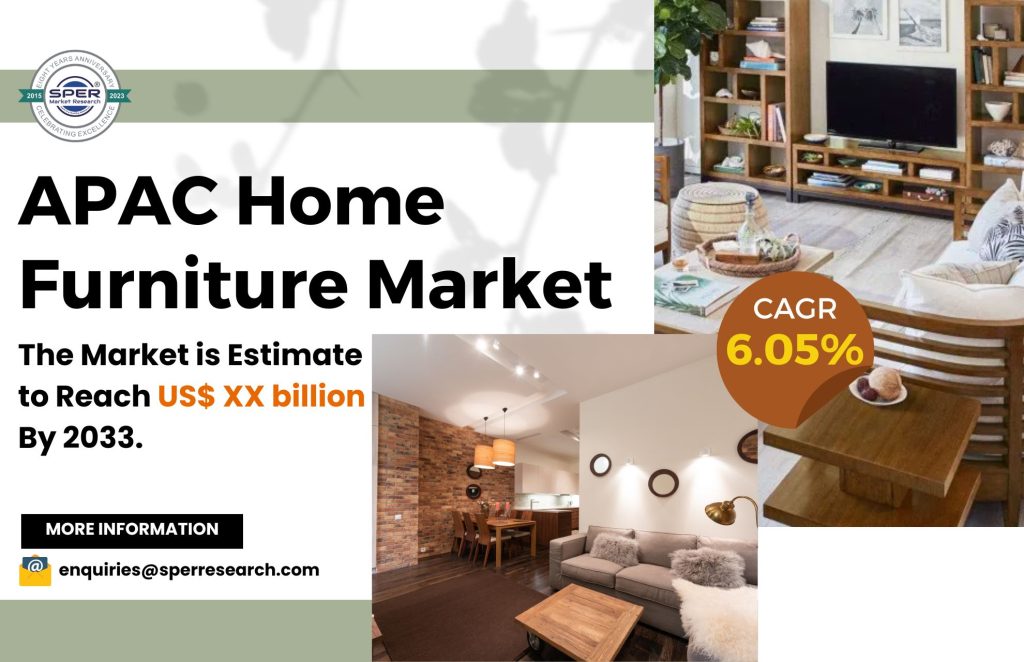
Asia Pacific Home Furniture Market

Asia Pacific Home Furniture Market Growth 2024, Rising Trends, Industry Share, Demand, Key Manufacturers, Revenue, Challenges and Forecast till 2033: SPER Market Research

Market Overview and Growth Insights: The term “home furniture” describes the moveable fixtures and furnishings that are used in homes to improve comfort, usefulness, and visual appeal. Products including couches, chairs, tables, beds, storage cabinets, and ornamental objects are all included in this category. In addition to supporting everyday activities like eating, sleeping, sitting, and storing, furniture also adds to a home’s overall interior design. To adapt to shifting consumer tastes, the furniture industry has changed over time, introducing new materials, styles, and technical developments. Contemporary home furnishings frequently combine style and utility, providing multifunctional designs that accommodate smaller living areas. Regional design trends, lifestyle shifts, and discretionary money all have an impact on the home furniture market.

According to SPER Market Research, Asia Pacific Home Furniture Market Size- By Product, By Distribution Channel- Regional Outlook, Competitive Strategies and Segment Forecast to 2033’ states that the Asia Pacific Home Furniture Market is estimated to reach USD 210.63 billion with a CAGR 6.05%.

Drivers: Several key factors are contributing to the growth of the Asia Pacific furniture market. More and more people are able to afford better quality furniture due to rising disposable incomes, especially in developing countries such as China and India. Rapid urbanization in the region has increased the demand for stylish and functional furniture for congested urban areas. Personalized and customizable furniture is also gaining popularity due to changing consumer tastes. Customers are increasingly looking for designs that reflect their unique tastes and lifestyles. Technological innovations such as artificial intelligence (AI), augmented reality (AR), and virtual reality (VR) have also completely changed the way people shop. These innovations have made online platforms more interactive and user-friendly, while providing a more personalized and efficient furniture shopping experience.

Download sample PDF copy of this report to understand structure of the complete report @ https://www.sperresearch.com/report-store/asia-pacific-home-furniture-market.aspx?sample=1

Restraints: The home furnishings market in Asia-Pacific has a number of obstacles to overcome despite its potential for expansion. Supply chain disruptions are one of the main problems, and they were most noticeable during the COVID-19 pandemic. Businesses and customers are frustrated as a result of these disruptions, which have caused delays in product availability and delivery schedules. Furthermore, consumer expenditure on non-essential items like house furnishings may be impacted by economic uncertainty brought on by shifting inflation rates or financial crises. With so many domestic and foreign competitors, the market is also extremely competitive, making it challenging for newcomers to make a name for themselves. Additionally, manufacturers are under more and more pressure to use sustainable materials and processes, which frequently raises production costs and necessitates large investments.

Impact of COVID-19: The Asia-Pacific home furnishings market was drastically altered by the COVID-19 pandemic. Many customers resorted to internet platforms for furniture shopping as physical businesses faced closures or restrictions, which greatly increased e-commerce sales. The increasing usage of AI, AR, and VR technologies, which enabled customers to see furniture in their homes before making a purchase, hastened this shift towards online buying. Consumer behaviour also changed as a result of the pandemic, with many people spending more time at home and concentrating on comfort and home renovation. Although the pandemic’s economic effects momentarily decreased spending on non-essential items, which caused a slowdown in demand, the long-term effects for e-commerce and the consumption of furniture at home are still favourable.

Key Players: The Asia-Pacific home furniture market is led by China, attributed to its fast-paced urbanization and substantial population size. Prominent companies in this market include International Furniture Co., Ltd., Cassina IXC Ltd., Bals Corporation, Godrej Interio, and Zuari Furniture.

Asia Pacific Home Furniture Market Segmentation:

By Product: Based on the Product, Asia Pacific Home Furniture Market is segmented as; Living-Room and Dining-Room Furniture, Bedroom Furniture, Kitchen Furniture, Lamps and Lighting Furniture, Plastic and Other Furniture.

By Distribution Channel: Based on the Distribution Channel, Asia Pacific Home Furniture Market is segmented as; Supermarkets/Hypermarkets, Specialty Stores, Online, Other Distribution Channels.

By Region: This research includes data for China, Japan, India, South Korea, Australia, Indonesia, Others.

For More Information in Asia Pacific Home Furniture Market, refer to below link –

Asia Pacific Home Furniture Market Share

Others Industry Report –

  1. Qatar Catering Services Market Size- By Model, By Company, By Service Type, By End User- Regional Outlook, Competitive Strategies and Segment Forecast to 2032
  2. Asia-Pacific Automotive Lidar Market Size- By Image Projection, By Range Type, By Technology, By Application- Regional outlook, Competitive Strategies and Segment Forecast to 2033

Follow Us –

LinkedIn | Instagram | Facebook | Twitter

Contact Us:

Sara Lopes, Business Consultant – U.S.A.

SPER Market Research

enquiries@sperresearch.com

+1-347-460-2899

APAC Home Furniture Market

APAC Home Furniture Market Trends 2024- Industry Share, Revenue, Growth Drivers, Business Challenges, Opportunities and Future Competition till 2033: SPER Market Research

The term “furniture” refers to mobile items that enable a variety of human activities such as sleeping, eating, and working with objects while seated, such as tables, chairs, stools, beds, and hammocks. Furniture also serves as a place to store items or hold objects at a suitable working height, such as tables and desks, which are horizontal surfaces above ground. It can be fashioned from a variety of materials, including metal, plastic, and wood. Furniture can be created with a variety of woodworking joints and frequently reflects local culture. Depending on the intended use, furniture designs can be updated utilising both machine and manual methods. 

According to SPER market research, Asia Pacific Home Furniture Market Size- By Product, By Distribution Channel – Regional Outlook, Competitive Strategies and Segment Forecast to 2033’ state that the Asia Pacific Home Furniture Market is predicted to reach USD XX billion by 2033 with a CAGR of 6.05%. 

Drivers: 

Technology is gradually being integrated into furniture, such as smart beds, sofas, and tables. As a result, market participants are gradually introducing smart furniture. For example, in July 2023, Ebarza unveiled its one-of-a-kind range of smart furniture. The furniture pieces are precisely designed to combine mechanical improvements with exquisite aesthetics, maximising space utilisation and providing different functionality in a single, flexible unit. In November 2023, Living Spaces, a well-known furniture company, and Diamond Mattress introduced the Adaptive Sleep smart bed, a significant advancement in sleep technology. Living Spaces and Diamond Mattress cooperated to create the Adaptive Sleep mattress, which combines advanced body-sensing technology with mobile app connectivity. This technology seeks to improve sleep quality by adapting to each individual’s unique sleeping habits. Furthermore, the mattress can be combined with an adjustable foundation to provide personalised comfort. As a result, these new product introductions are expected to create opportunities for market expansion. 

Challenges: 

The limited supply of qualified manpower, longer product replacement cycles, environmental concerns, and rising manufacturing costs will all stymie the expansion of the wooden furniture market over the forecast period. Furthermore, the high cost and the need to increase supply chain visibility and efficacy may impede the target market’s growth. Furthermore, the middle-class prefers to buy low-cost, second-hand home furniture over expensive ones. This is expected to slow market expansion. Furthermore, stiff competition from unorganised industry competitors in many places throughout the world is constraining major firms’ commercial expansion. Fluctuating raw material prices and shifting import and customs duties on fixture products in many countries across the world are projected to stymie overall industry growth. 

Request For Free Sample Report @ https://www.sperresearch.com/report-store/asia-pacific-home-furniture-market.aspx?sample=1

Impact of COVID-19 on Asia Pacific Home Furniture Market

The COVID-19 pandemic had a significant impact on consumer behaviour and industrial trends in the furniture sector. Due to financial constraints, buyers were hesitant to spend on non-essential items, particularly home interiors, and therefore residential demand for furniture declined. Following the COVID-19 pandemic, there has been a slow but gradual return to home projects, and consumers are once again eager to spend on household items, driving increased demand for furniture over the forecast period. 

Asia Pacific Home Furniture Market Key Players:

China dominates the Home Furniture market in Asia Pacific. The revenue of the Chinese furniture market has steadily increased over the years, with living room furniture, home décor, and bedroom furniture accounting for the majority of sales. Furthermore, the market’s major players include Markor International Furniture Co, Ltd, Cassina IXC Ltd, Bals Corporation, Godrej Interio, Zuari Furniture, Dalian Huafeng Furniture Group Co Ltd, and Others. 

Asia Pacific Home Furniture Market Segmentation:

The SPER Market Research report seeks to give market dynamics, demand, and supply forecasts for the years up to 2033. This report contains statistics on product type segment growth estimates and forecasts.

By Product: Based on the Product, Asia Pacific Home Furniture Market is segmented as; Living-Room and Dining-Room Furniture, Bedroom Furniture, Kitchen Furniture, Lamps and Lighting Furniture, Plastic and Other Furniture.

By Distribution Channel: Based on the Distribution Channel, Asia Pacific Home Furniture Market is segmented as; Supermarkets/Hypermarkets, Specialty Stores, Online, Other Distribution Channels.

By Region: This research includes data for China, Japan, India, South Korea, Australia, Indonesia, Others.

This study also encompasses various drivers and restraining factors of this market for the forecast period. Various growth opportunities are also discussed in the report.

For More Information, refer to below link:-

Asia Pacific Home Furniture Market Future Outlook

Related Reports:

India Online Furniture and Home Decor Market Size- By Product Category, By Furniture Items, By Furnishing Items, By Furnishings and Home Decor, By Usage- Regional Outlook, Competitive Strategies and Segment Forecast to 2032

Asia Pacific Office Furniture Market Size- By Material, By Product, By Distribution Channel- Regional Outlook, Competitive Strategies and Segment Forecast to 2033

Follow Us –           

LinkedIn | Instagram | Facebook | Twitter

Contact Us:

Sara Lopes, Business Consultant – U.S.A.

SPER Market Research

enquiries@sperresearch.com

+1-347-460-2899