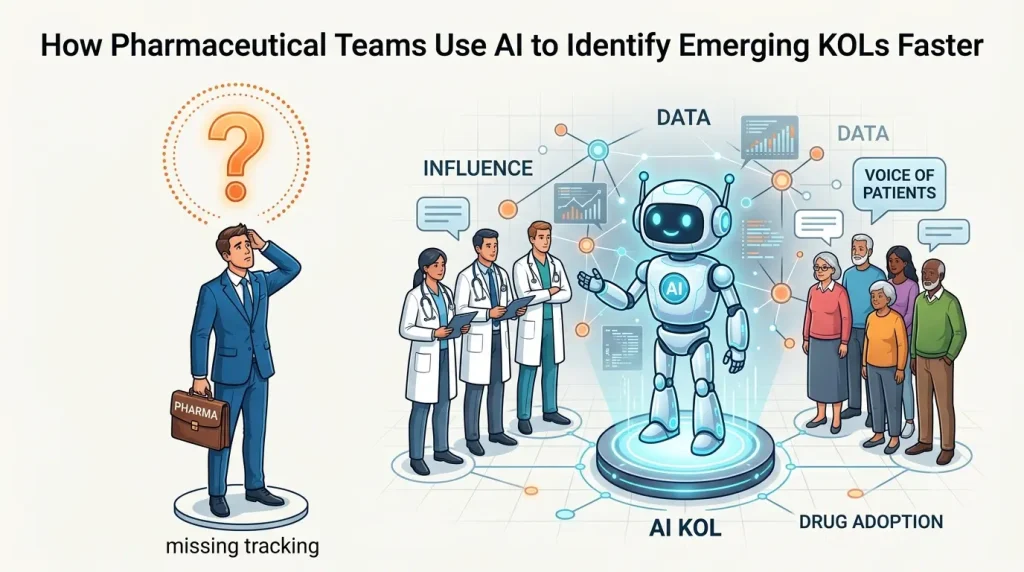
In the fast-moving world of pharma and biotech, staying ahead means knowing who the right experts are—before your competitors do. Key Opinion Leaders (KOLs) play a critical role in shaping clinical conversations, influencing prescribing behavior, and driving medical education. But finding the right KOLs at the right time has traditionally been slow, manual, and often unreliable.
That’s where artificial intelligence is changing the game.
The Old Way vs. The New Way
Not long ago, pharmaceutical teams relied on:
- Sales rep networks and personal relationships
- Manual literature reviews and conference attendance lists
- Spreadsheets built from fragmented data sources
- Gut instinct over data-driven decisions
This approach took weeks — sometimes months. And by the time a KOL was identified and engaged, the window of opportunity had often already closed.
Today, teams using an AI-powered KOL mapping platform for pharma can identify emerging experts in hours, not weeks.
What Makes AI So Effective at KOL Discovery?
AI doesn’t just search — it understands. Modern tools go far beyond simple keyword matching. They analyse:
- Published research and clinical trial authorship
- Conference presentation history
- Social media and digital footprint
- Citation networks and co-authorship patterns
- Congress speaking invitations and advisory board memberships
This is the power of a semantic KOL search platform — it reads context, not just words. So when a new therapy area emerges, AI can instantly surface researchers who are gaining influence, even if they haven’t yet reached “traditional” KOL status.
Why Emerging KOLs Matter More Than Ever
Many pharma teams focus only on established, well-known experts. But emerging KOLs — those rising researchers and clinicians gaining traction in a specific niche — often offer:
- Fresher perspectives aligned with cutting-edge science
- Greater accessibility for collaboration and partnerships
- Faster relationship-building before they become widely known
- Stronger digital influence among peer networks
A good KOL engagement intelligence software helps medical affairs teams spot these rising voices early, giving companies a meaningful head start.
How AI-Driven Platforms Actually Work
How AI-Driven Platforms Actually Work
Here’s a simplified breakdown of how a modern AI-driven medical affairs analytics tool identifies KOLs:
- Data Ingestion — The platform pulls data from thousands of sources: PubMed, ClinicalTrials.gov, congress databases, social platforms, and news mentions.
- Influence Scoring — Using machine learning, it assigns influence scores based on publication impact, citation frequency, peer recognition, and digital engagement.
- Network Mapping — It visualises relationships between experts, showing who collaborates with whom and who sits at the centre of key conversations.
- Real-Time Tracking — Unlike static databases, a real-time KOL intelligence platform continuously updates as new papers are published, trials are registered, or a clinician speaks at a major congress.
- Therapy Area Filtering — Teams can drill down by disease area, geography, or specialty — making it ideal for both global pharma and KOL identification software for biotech companies operating in niche indications.
The Medical Affairs Advantage
Medical affairs teams are under increasing pressure to engage the right experts with the right message at the right time. A best KOL intelligence software for medical affairs does more than identify names — it provides deep context:
- What is this expert currently researching?
- Which peers do they trust and collaborate with?
- Where are they speaking next?
- How has their influence grown over the past 12 months?
With a healthcare professional network analytics platform, medical affairs leaders can make strategic, evidence-based engagement decisions — not guesses.
Turning Data Into Relationships
Technology alone isn’t the answer. The real value of a pharma scientific influence tracking platform lies in how teams act on the insights. AI surfaces the opportunities — but it’s the human relationship, the meaningful scientific exchange, and the genuine collaboration that builds lasting KOL partnerships.
Think of AI as your research engine and your medical affairs team as the relationship architects.
Final Thoughts
The race to identify and engage the right KOLs is getting faster. Pharma and biotech companies that invest in a pharmaceutical expert discovery platform today are building a strategic advantage that compounds over time.
The question isn’t whether AI will reshape KOL strategy — it already is. The question is whether your team is using it.
Looking to upgrade your KOL identification process? Explore how AI-powered tools can help your medical affairs team move faster, smarter, and with greater confidence.