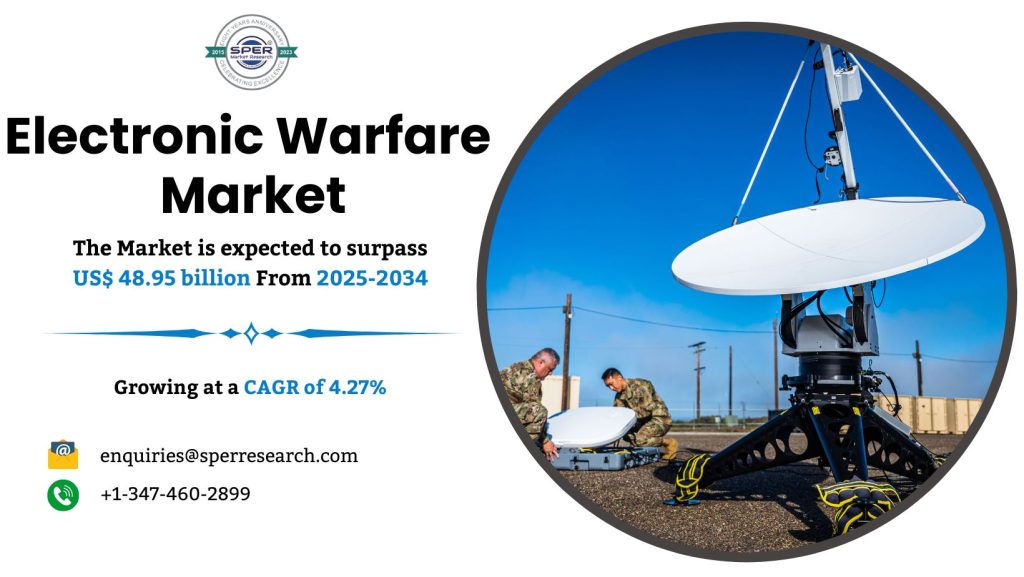
Electronic Warfare Market
June 23, 2025 Business, IT Industry

Electronic Warfare Market Growth, Demand and Outlook 2034

Electronic warfare (EW) is the strategic use of the electromagnetic spectrum (EMS) to detect, intercept, deceive, or disrupt enemy electronic systems while defending friendly forces against similar actions.  As modern military operations rely more on advanced electronic systems like radar, communications, and navigation tools, electronic warfare (EW) has emerged as a critical component of national defense and security strategies.  EW operations are broadly divided into three categories: electronic support (ES), electronic attack (EA), and electronic protection (EP).  Electronic support is the monitoring and analysis of electromagnetic signals in order to gather intelligence or identify threats.  Electronic attacks include actions that degrade, neutralize, or destroy adversary capabilities, such as jamming enemy radar or communications.

According to SPER Market Research, ‘ Global Electronic Warfare Market – By Platform, By Product, By Frequency, By End-User – Regional Outlook, Competitive Strategies and Segment Forecast to 2033′ states that the Global Electronic Warfare Market is estimated to reach USD 48.95 billion by 2033 with a CAGR of 4.27 %.

The global Electronic Warfare (EW) market is expanding rapidly, owing to rising geopolitical tensions, advances in military technology, and rising defense budgets around the world.  Modern conflicts prioritize electromagnetic spectrum dominance, requiring countries to invest in EW systems for both offensive and defensive operations.  The addition of artificial intelligence (AI) and machine learning to EW platforms improves real-time threat detection and response capabilities, making such systems more appealing to defense agencies.  Furthermore, the growing reliance on radar and communication jamming, electronic countermeasures (ECM), and cyber-electronic warfare drives technological innovation in this field.  Furthermore, the proliferation of unmanned systems and autonomous platforms has increased the demand for EW capabilities that can effectively counter evolving threats.

Request a Free Sample Report: https://www.sperresearch.com/report-store/electronic-warfare-market?sample=1

The global Electronic Warfare (EW) market, while rapidly expanding, faces a number of critical challenges that could stymie its growth and implementation.  One significant challenge is the growing complexity of the electromagnetic spectrum, which necessitates advanced signal processing and real-time decision-making capabilities.  As spectrum congestion increases, distinguishing between friend and foe signals becomes more difficult.  Another major challenge is the integration of EW systems with existing military platforms, which frequently raises compatibility and interoperability concerns, particularly in multinational operations.  Furthermore, cybersecurity risks pose a significant threat to EW systems because adversaries can exploit vulnerabilities to disable or manipulate them, blurring the distinction between cyber and electronic warfare.

The United States remains the dominant player in the global Electronic Warfare (EW) market, owing to its significant and ongoing investment in advanced defense technologies. Some of its key players are- BAE Systems, Boeing Company, Elbit Systems Ltd, Harris Corporation, L3Harris Technologies, Inc

For More Information, refer to below link: –  

Electronic Warfare Market Growth

Related Reports:  

Global Next-Generation Memory Market

Global IoT Node and Gateway Market

Follow Us – 

LinkedIn | Instagram | Facebook | Twitter 

Contact Us: 

Sara Lopes, Business Consultant — USA 

SPER Market Research 

[email protected] 

+1–347–460–2899

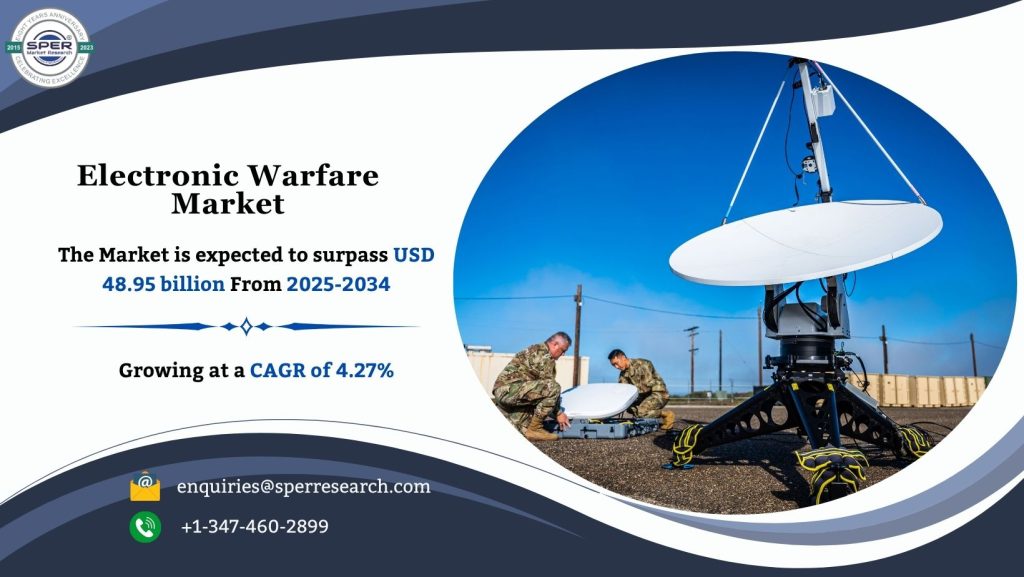
Electronic Warfare Market
April 30, 2025 Business

Electronic Warfare Market Size, Share, Industry Reports, Analysis, Key Players and Business Opportunities 2034: SPER Market Research

Electronic warfare refers to military activities that use the electromagnetic spectrum and accompanying technology, such as infrared (IR) detectors and radars, to intercept attacks and defend allied soldiers. This strategic strategy employs jammers, decoys, countermeasure systems, and directed energy weapons to improve range, spectral domain, security, environmental awareness, and decision-making support. Armed forces use electronic warfare extensively to provide intelligence and combat solutions, including threat detection, analysis, interruption, and localisation. As a result, electronic warfare systems are widely used across naval, ground, space, and aerial platforms.

According to SPER market research, ‘Global Electronic Warfare Market Size- By Platform, By Product, By Frequency, By End-User – Regional Outlook, Competitive Strategies and Segment Forecast to 2034’ state that the Global Electronic Warfare Market is predicted to reach 48.95 billion by 2034 with a CAGR of 4.27%.

Drivers:

The global electronic warfare (EW) market is growing mainly due to rising geopolitical tensions and defense modernization efforts. Increased funding for research and development (R&D) leads to innovation in EW technologies, especially in quantum computing and artificial intelligence (AI) for electronic attack (EA), electronic protection (EP), and electronic support (ES). The use of machine learning for real-time threat analysis shows significant technological progress. Cognitive electronic warfare systems, using AI for automated threat detection and response, highlight the shift towards more advanced EW solutions.

Request a Free Sample Report: https://www.sperresearch.com/report-store/electronic-warfare-market?sample=1

Restraints:

Electronic warfare systems provide considerable hurdles due to their inherent complexity and interoperability issues. These systems require complicated technology, various capabilities, and integration issues, making the design, development, and deployment processes extremely complex. To successfully negotiate these difficulties, specialised skills, large resources, and coordination among various parties are required. Furthermore, interoperability challenges develop when electronic warfare systems from several vendors use proprietary designs, protocols, and interfaces. Seamless communication and coordination among various electronic warfare systems and platforms are critical for maximising their efficacy in combined military operations.

The growth of the electronic warfare (EW) market in North America is mainly due to significant investments in defense capabilities to counter emerging threats and maintain technological superiority. The U. S. Department of Defense prioritizes EW for national security and focuses on research and development of advanced EW systems. This includes technologies for electronic attack (EA), electronic protection (EP), and electronic support (ES). There is a strategic shift toward integrating cyber warfare with traditional EW, and collaborations with defense contractors and advancements in software-defined radio, AI, and machine learning support the region’s EW market growth. Some of the key market players are BAE Systems, Boeing Company, Elbit Systems Ltd, Harris Corporation, L3Harris Technologies, Inc, Lockheed Martin Corporation, and others.

For More Information, refer to below link: –  

Electronic Warfare Growth 

Related Reports:

Interactive Display Market Growth, Size, Trends Analysis – By Display Type, By Application – Regional Outlook, Competitive Strategies and Segment Forecast to 2034

Serverless Computing Market Growth, Size, Trends Analysis – By Service Model, By Deployment, By Enterprise Size, By End-User – Regional Outlook, Competitive Strategies and Segment Forecast to 2034

Follow Us – 

LinkedIn | Instagram | Facebook | Twitter 

Contact Us: 

Sara Lopes, Business Consultant — USA 

SPER Market Research 

[email protected] 

+1–347–460–2899